
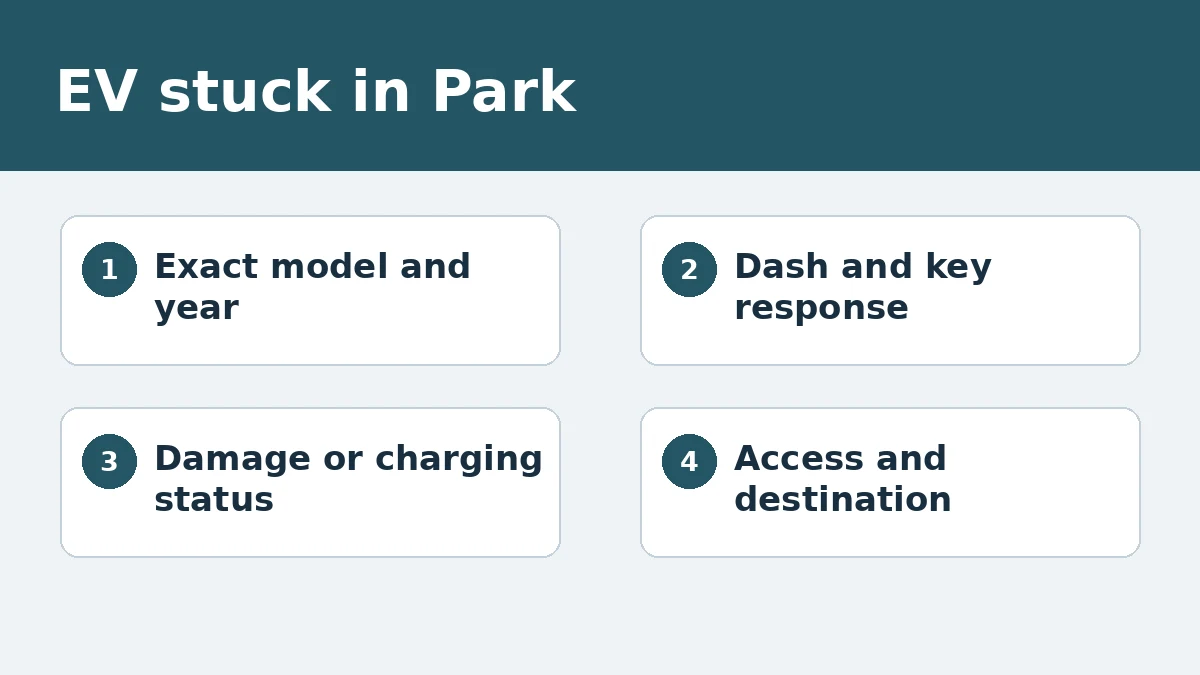
If your EV won’t shift into Neutral, tell the tow dispatcher it may be locked in Park before the truck is sent. Give the exact model and year and say whether the screen and locks still respond. Transport requirements vary by vehicle. Knowing its state helps the operator plan how to load it without relying on the wheels rolling freely.
Start with a safe pickup location
If the EV is stopped in a traffic lane, there has been a collision, or there is smoke, fire or an immediate danger, call 911 and follow the emergency dispatcher’s directions. Tell them it is an EV or plug-in hybrid if you know. Do not approach exposed cables or try to move a damaged vehicle while waiting for instructions. A car that is safely parked can be a routine assistance call, but report any impact underneath, visible damage or unusual warning that occurred before it stopped.
Give dispatch your street address or road and direction of travel. If you are in a large lot along Westnedge Avenue, add the nearest entrance, store or parking row. If you are at a charger, identify the site and the stall if available, and say whether the charge cable is still connected. If the car is behind access control, tell dispatch who can open the gate or which entrance a truck can use. Give those details before sending a pin so the operator has a way to interpret it.
Report what works and what doesn’t
- Does the dashboard turn on? Read the exact message, if you can do so safely.
- Can you unlock the car, and do you have the key, card or phone used to access it?
- What charge level was last shown, and was the car connected to a charger?
- Was there an impact, flooding or visible damage? Share that before normal dispatch proceeds.
A traction-battery reading describes the energy available for driving. It doesn’t tell dispatch whether the car can enter a transport mode. Use the emergency towing or transport section of the owner’s manual for your specific model and year. For example, Tesla’s transporter instructions for the US 2017–2023 Model 3 explain conditions that can affect loading. Other EVs can have different requirements. The operator should confirm the method.
Describe the screen, gear and access separately
The center screen may work even though the car refuses a shift command. A display may also be blank. Say whether the doors unlock, whether the key, card or phone is available, and what the gear indicator says. If the car says it cannot shift or displays a warning, give the text if you already have it. A screenshot or picture from a safe spot can supplement your report. There is no need to repeat a shift attempt to capture it.
A stuck charge connector, a car that will not respond to its key and a car that cannot roll are separate details for dispatch. Tell the operator which ones apply. If one wheel is damaged or pressed against a curb, say where it is. Note if the parking brake stayed on, if the steering can turn normally, or if the operator will need another way to access the car. Give the model year and exact model when you can. You do not need to determine whether the issue is with the low-voltage system, the battery or software. If dispatch directs you to the Portage jump-start and battery assistance team, confirm they can help with your specific EV before anyone attempts a jump start.
Use the manual for the exact model
Model-specific transport instructions can distinguish loading from moving a vehicle on the road. An instruction that applies while getting a car onto a truck may have limits that make it unsuitable for any other use. If you found a procedure in the manual, give the operator the manual version or the model it covers and tell them what you already tried. The Tesla guide linked above is for a specific generation of Model 3. A similar-looking control on another model may have different requirements.
Tell dispatch if you believe the car briefly displayed Neutral or a transport mode then returned to Park. Some displayed information can change after the vehicle loses power or after an access step. The operator needs the present condition and anything likely to change it. If the car still will not move, do not force it out of Park, push it on a slope or improvise a way to drag it. The operator can plan the equipment and loading method after assessing the car and its surroundings.
Explain the approach to the car
At a charging site near Westnedge Avenue, share the property address, stall or level, and the entrance a truck can use. In a garage, tell dispatch the posted height clearance if you can see it safely. Mention if the vehicle is nose-in or a curb limits the approach. A pin alone may send a driver to the wrong side of the property. Use the City of Portage construction page if roadwork affects the entrance.
Explain the space the operator has to work with
Two cars of the same model can require different pickup plans. One may be in a level driveway with a clear approach. The other may be parked nose-in against a wall in a garage. Describe which way the EV points, whether there is room behind it and how close the next vehicle or post is. A garage height notice, tight turn or sloped entrance can affect which truck can reach it. If you have a wide photo taken safely, it may show more than a close-up of the car.
Tell dispatch what surface the EV is on and whether there is an obstruction between the road and the car. If a property manager needs to authorize access, give them advance notice and share their contact details with dispatch if appropriate. For a vehicle at a public charger, tell the location operator if the charging connection is part of the problem. Let the tow operator coordinate safe access and loading. Do not try to change the car’s position to save time while the truck is on its way.
Confirm where the EV should go
A repair facility and a public charger solve different problems. If the EV will not power on or will not shift, ask the receiving facility whether it can take the vehicle in its current state and when someone can meet the truck.
Choose a destination before the car is loaded
Ask the dealer, service center or repair facility if it can receive the specific EV and handle the condition you reported. Tell it whether the car is still stuck in Park or may arrive after hours. Get the driveway, drop-off point and key instructions from the receiving location. If you are using manufacturer roadside assistance, insurance or a fleet plan, ask who approves the destination, and whether you need a reference number for the tow.
Tell dispatch if there is a deadline at the destination or if the car cannot roll once it arrives. Ask which parts of the pickup and delivery the quote covers. See the Portage towing cost guide for questions you can ask when comparing quotes. If the receiving location turns out to be unavailable, check with the party authorising the tow before choosing a different place. At delivery, confirm who received the key or access card and how to reach the facility next. Keeping the fault message, towing receipt and destination instructions together will help the service advisor reconstruct what happened.
See Portage EV towing, flatbed options and Portage coverage. Contact Portage Tow Truck with the model, access details and receiving location.