Flatbed available 24 hours in Portage
Flatbed Towing in Portage, MI
All four wheels off the ground, nothing rotating, nothing dragging. The right call for all-wheel drive, low-clearance, electric and accident-damaged vehicles anywhere in Kalamazoo County.
The safest way to move a car
What Flatbed Towing Actually Does
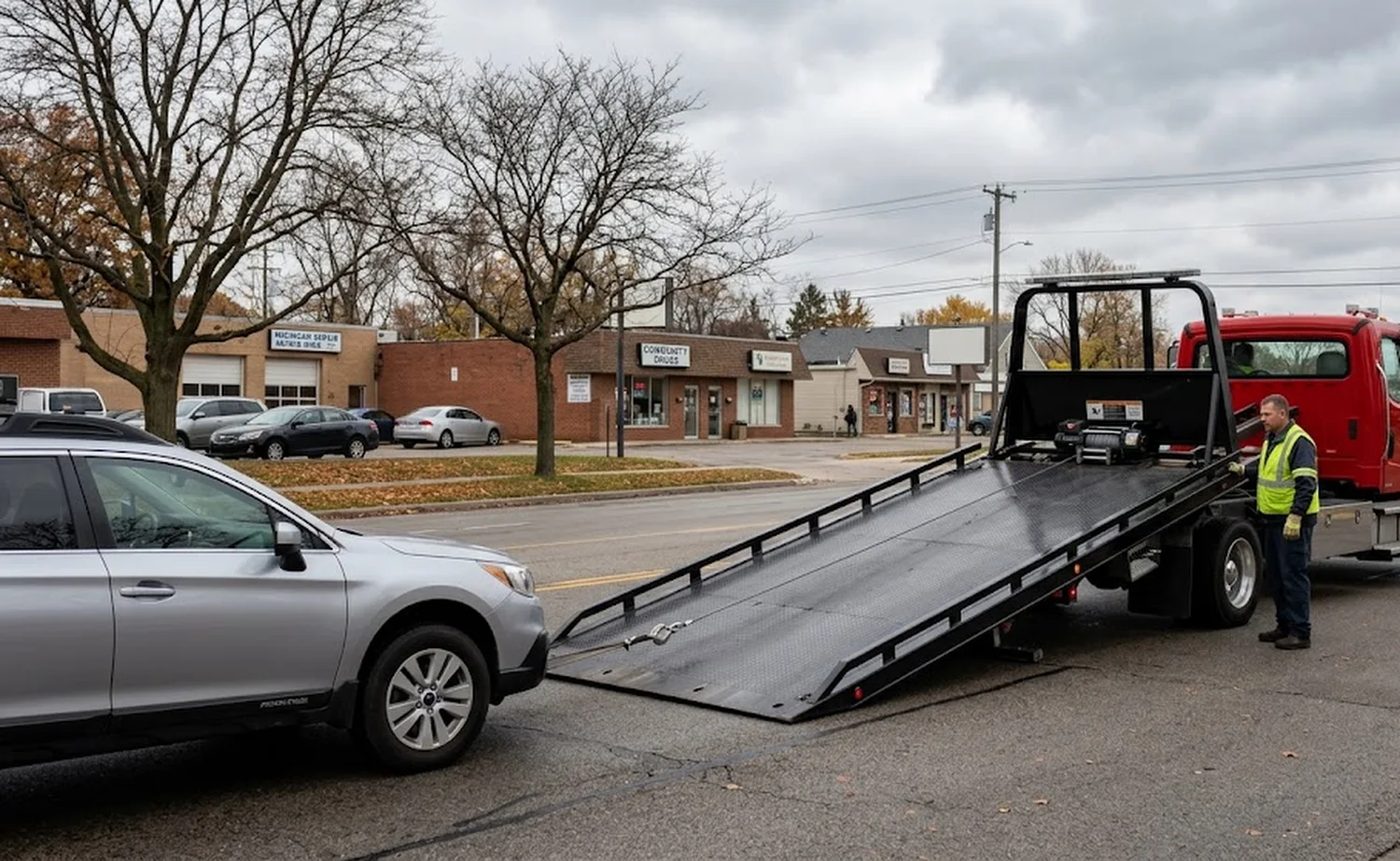
A flatbed — or rollback — tilts its deck down to the road, winches your vehicle up, and carries it completely off the ground. Nothing on your car touches pavement between where it broke down and where it’s going.
That matters more than most people realize. When a vehicle is towed with two wheels still rolling, the driveshaft and transmission internals keep spinning — but the engine isn’t running, so the transmission pump isn’t circulating fluid. On a front-wheel-drive car over a short distance that’s usually survivable. On all-wheel drive it can cook a transfer case in a few miles.
A flatbed removes that risk entirely. It’s why we default to it for anything we’re not certain about, and why it’s the only method we’ll use on an AWD vehicle going farther than across a parking lot.
Send a flatbed if your vehicle is…
Start to finish
How We Load a Flatbed
Most flatbed loads take eight to twelve minutes on scene. Here’s what those minutes involve.
Assess and position
The operator checks drivetrain, clearance and whether the wheels turn freely, then sets the truck so the deck runs straight at your vehicle. On a shoulder that means cones out and the truck angled to shield the work area from traffic.
Tilt and winch
The deck tilts back to meet the road. The winch line attaches to the frame or a designated tow point — never a bumper or suspension arm — and pulls the vehicle up under control rather than dragging it.
Four-point tie-down
Straps go over the tires at all four corners, not around axles or control arms. That puts the tension into the tire and rim, which is what they’re built to take, and keeps chains off your paint and brake lines.
Transport and unload
We take it where you tell us — your mechanic, your dealership, your driveway. We don’t run a repair shop, so we have no reason to steer you anywhere in particular.
Where we run it
Flatbed Calls We Take Around Portage
I‑94, exits 74 to 80
Highway breakdowns get a flatbed by default. At interstate speeds a vehicle that stopped for an unknown reason isn’t worth risking on two wheels, and a flatbed clears the shoulder faster — which matters when you’re standing next to live traffic.
Crossroads Mall & South Westnedge
Parking-lot no-starts, mostly. Plenty of room to tilt the deck, and we can usually load without moving surrounding vehicles.
Winter driveway recoveries
After a lake-effect snowfall we get calls from Lake Center and the Austin Lake neighborhoods where a car has sat frozen for days. Brakes seize to the rotors; a flatbed and a winch move it without tearing anything.
Kalamazoo/Battle Creek Airport
Long-term parking kills batteries and flat-spots tires. If it won’t roll properly after two weeks in the cold, it goes on the deck.
US‑131 and Shaver Road
The Center Avenue and Milham interchanges are regular call locations, particularly in the first hard freeze of the season.
Dealership and shop transfers
Scheduled, non-urgent moves around Kalamazoo County. Schedule these ahead and we’ll work them around the emergency queue.
Straight answers
Flatbed Towing Questions
Why does my all-wheel drive car need a flatbed?
Does flatbed towing cost more than a wheel-lift?
Can a flatbed get into a low parking garage?
Will the straps damage my wheels or paint?
Do electric vehicles have to go on a flatbed?
Can you flatbed a car that won’t roll or steer?
Can you carry more than one vehicle at a time?
Related Services
Wheel-Lift Towing
The faster, lower-cost option for standard front- or rear-drive cars and for low-clearance garages.
Long-Distance Towing
Portage to Grand Rapids, Detroit or Chicago, carried on the deck the whole way.
Winch-Out & Recovery
If it’s in a ditch or a snowbank, it needs pulling out before anything goes on a deck.
Need a Flatbed in Portage?
Tell us the drivetrain and where you are. We’ll give you an ETA and a price on the call.
Portage, MI 49002 & 49024
Phone: (269) 350-8697
Email: info@portagetowtruck.com
Open 24 hours, 7 days a week