Heavy recovery dispatched 24 hours from Portage
Heavy-Duty Towing in Portage, MI
Semis, box trucks, buses, RVs and equipment. When the vehicle weighs more than the tow truck most companies own, you need a wrecker rated for the job and an operator who has done it before.
Class 7 and 8 capability
What Counts as Heavy-Duty
The industry line sits at 26,000 pounds gross vehicle weight rating. Above that you are into Class 7 and Class 8 territory, and a standard rollback or wheel-lift is not rated to touch it — not because the operator lacks skill, but because the boom, the winch line and the truck’s own axle weights are all specified for something smaller.
Heavy-duty work is also a different discipline. A light-duty tow is mostly a hook-up. A heavy recovery is a rigging problem: where the load sits, which axles carry it, what the ground underneath will bear, and how to move it without pulling the frame out of square or dropping a trailer on the shoulder.
We run heavy-duty alongside our light and medium fleet, so the same phone number gets you the right truck either way. When you call, tell the dispatcher the vehicle type, whether it is loaded, and what it is sitting on. Those three answers decide which wrecker leaves the yard, and getting them right on the first call is the difference between one trip and two.
One thing worth saying plainly: we tow and recover, we do not repair. We have no shop and no service bays, so there is no incentive on our side to bring your truck anywhere in particular. It goes to the shop, terminal or yard you name.
What we take on heavy-duty
Beyond a straight tow
What a Heavy Recovery Actually Involves
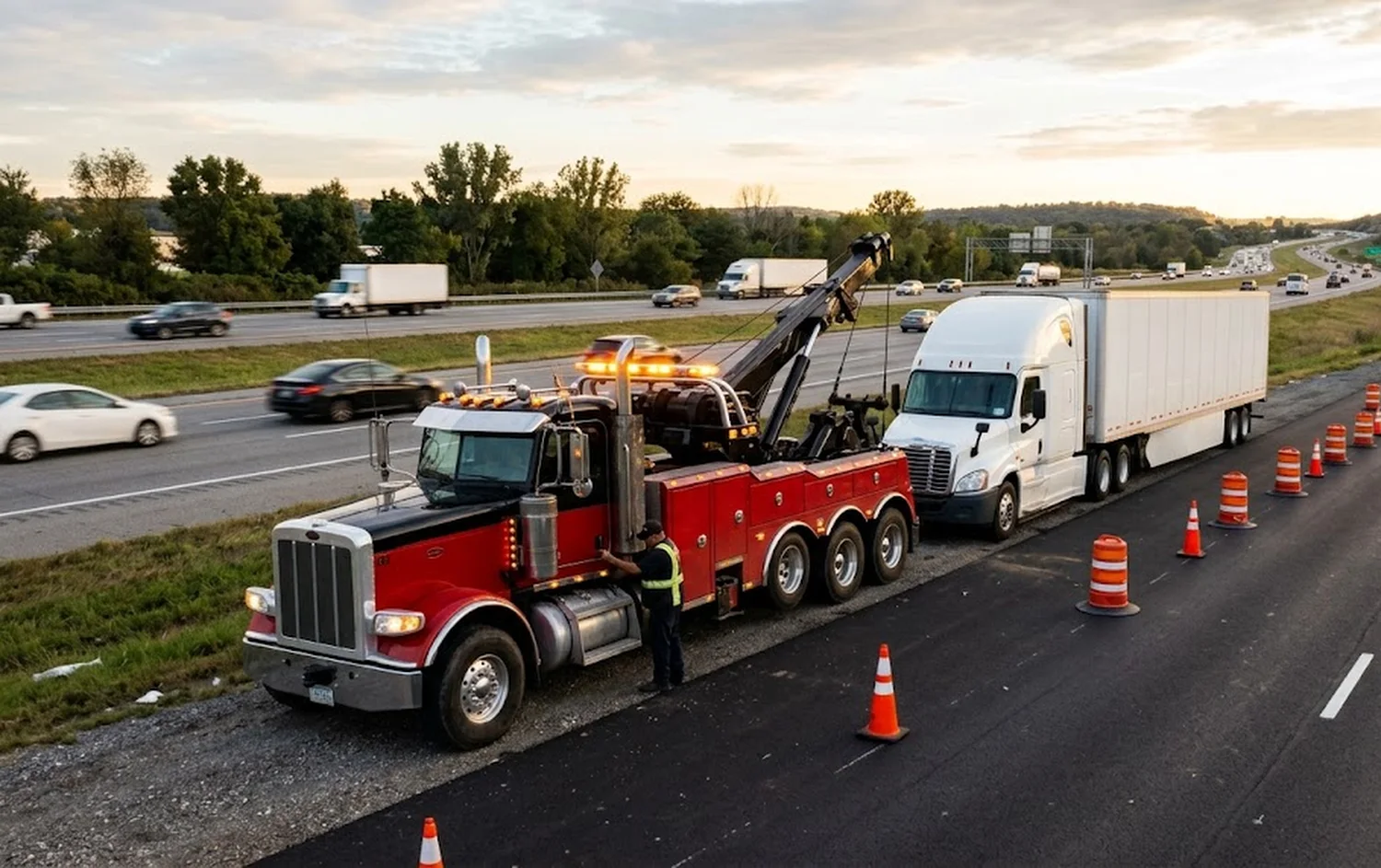
Most heavy calls are not a truck sitting neatly on a shoulder waiting to be hooked. They are a vehicle somewhere it should not be, often with cargo on board and traffic going past at seventy.
Scene assessment first
Before anything is rigged, the operator works out the weight, where it is distributed, and what the ground will hold. Soft shoulder, frozen ground and wet clay all change the plan.
Traffic control
A Class 8 recovery on a live freeway needs the lane protected before a winch line goes anywhere. We coordinate with MSP and county deputies as standard, not as an afterthought.
Uprighting rollovers
Rotating a loaded trailer back onto its wheels is a controlled pull with multiple lines, not one hard yank. Done wrong it damages more than the accident did.
Load shifts and transfers
Sometimes the freight has to come off before the truck can move. We can offload to a second trailer or arrange transfer so the load keeps moving.
Air-brake and driveline prep
Caging brake chambers, pulling axle shafts or removing driveshafts where the drivetrain cannot be allowed to turn. Skipping this step is how transmissions get destroyed in transit.
Ditch and embankment extraction
Winching out of the median or off an embankment with the pull angled so the vehicle comes up level rather than dragging on its side.
Where the heavy calls come from
Heavy-Duty Work Around Portage
The I-94 freight corridor
I-94 between Chicago and Detroit runs directly past Portage, and it carries serious truck volume. Exits 76 through 80 are our most frequent heavy calls — breakdowns, blowouts and shoulder incidents.
The US-131 interchange
Where US-131 meets I-94 southwest of Portage is a genuinely awkward piece of road for a loaded rig. Tight ramp radii and merging traffic produce more heavy incidents than the traffic count suggests.
Portage industrial and distribution sites
The warehousing along Sprinkle Road and around Portage Road generates yard moves, dock incidents and trucks that will not start at the end of a shift.
Kalamazoo/Battle Creek airport freight
Air freight and ground support equipment operate on a schedule that does not wait. Off-hours calls here are routine for us.
Farm equipment south of Portage
Around Vicksburg and Schoolcraft the heavy calls are tractors, combines and implements that have broken down mid-field or on a two-lane road.
Winter on the lake-effect belt
Kalamazoo County sits in the snow belt. Jackknifes and slide-offs cluster in the first hard storm of the season, and we staff for it.
Straight answers
Heavy-Duty Towing Questions
How big a vehicle can you actually tow?
How is heavy-duty towing priced?
My truck is blocking a lane on I-94. What happens first?
How long until you reach me?
Can you move the freight if the trailer can’t be towed?
Do you tow RVs and motorhomes?
Will you repair the truck once you’ve recovered it?
Do you handle fleet and insurance billing?
Related Services
Heavy Vehicle Down in Portage?
Tell us the vehicle, whether it’s loaded, and what it’s sitting on. We’ll send the right wrecker the first time.
Portage, MI 49002 & 49024
Phone: (269) 350-8697
Email: info@portagetowtruck.com
Open 24 hours, 7 days a week