Wheel-lift available 24 hours in Portage
Wheel-Lift Towing in Portage, MI
Faster to hook, cheaper than a flatbed, and narrow enough to get into places a rollback simply cannot. The right tool for standard cars on short local moves around Kalamazoo County.
Quick, tight, economical
How a Wheel-Lift Works
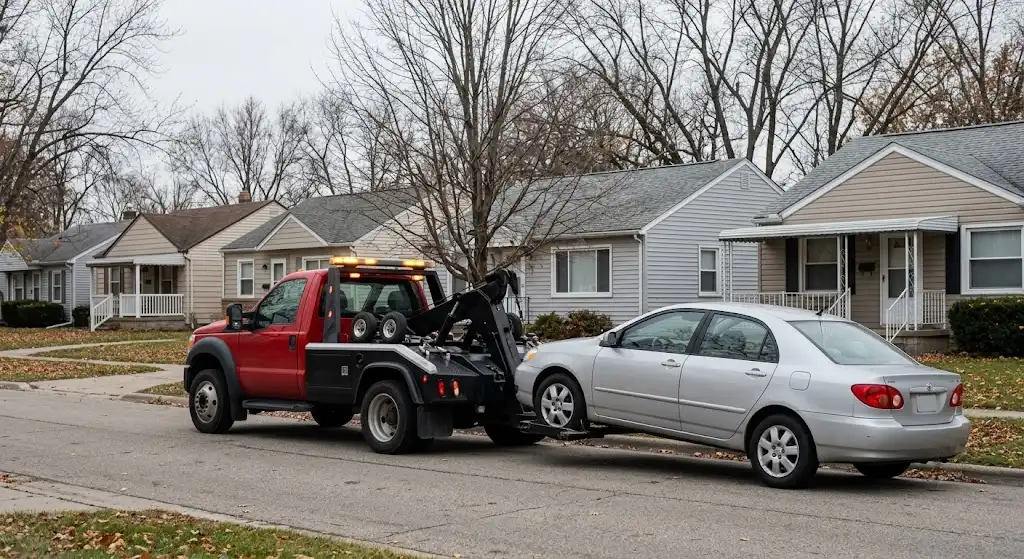
A wheel-lift is a hydraulic yoke that slides under two of your tires and lifts that end of the car clear of the road. The other two wheels stay down and roll. Nothing touches your bumper, frame or suspension at any point.
It replaced the old sling-and-hook trucks for a good reason. A sling pressed against bodywork and bumpers, which is how tow trucks earned their reputation for scraped paint and cracked valances. A wheel-lift only ever contacts the tires.
Two things make it the better choice in the right situation. It hooks up in about three minutes rather than ten, and the truck itself is far narrower and shorter than a flatbed — so it fits into apartment garages, tight lots and awkward parallel spots where a rollback has nowhere to tilt its deck.
The trade-off is that two of your wheels are rolling on the road for the whole journey. That’s fine for a front-wheel-drive Corolla going four miles to a shop on Westnedge. It is not fine for an all-wheel-drive Outback going to Grand Rapids.
Wheel-lift is the right call when…
Being straight with you
When We’ll Tell You to Take a Flatbed Instead
A wheel-lift is cheaper, so there’s a commercial temptation to use one on everything. We don’t. If your vehicle shouldn’t be on a wheel-lift, we’ll say so on the phone — before you’ve agreed to anything.
All-wheel and four-wheel drive
The wheels left on the road drive the transfer case and center differential with no fluid circulating. Some manufacturers permit very short distances at low speed; most don’t. It goes on a flatbed.
Electric and most hybrids
Rolling wheels turn the drive motor. Nearly every EV manufacturer specifies flatbed only, and it’s written into the owner’s manual.
Lowered or long-overhang cars
The yoke needs room under the tires. On a heavily lowered car there often isn’t any, and the rear bumper can drag as the front lifts.
Damaged suspension or seized wheels
If the free-rolling end won’t roll straight, a wheel-lift makes the problem worse over every mile. Dollies or a flatbed instead.
Anything going a long way
Highway miles on two rolling wheels add wear and heat. For a run to Detroit or Chicago the flatbed is worth the difference.
Classics and low-production cars
Not a mechanical rule, just judgment. If it would be painful to replace, it goes on the deck.
Where it earns its keep
Wheel-Lift Calls Around Portage
Apartment parking decks
The complexes off Romence Road and around Lake Center are our most common wheel-lift calls. Low ceilings, tight ramps and no room for a deck to tilt.
Downtown Kalamazoo parallel parking
A car boxed in front and back can’t be winched forward onto anything. A wheel-lift picks up one end and swings it out.
Crossroads Mall and Westnedge lots
Short hops to a shop a few miles away. Quick hook, low cost, no reason to send a bigger truck.
Illegally parked and blocked-in vehicles
Property managers around Portage call for these regularly. A wheel-lift is faster and does less damage than dragging.
Driveways with tight turns
Older Portage neighborhoods have narrow drives and mature trees. A shorter truck gets in and out without touching anything.
Second vehicle on a paired move
Where weight and length allow, a wheel-lift behind a loaded flatbed moves two cars to the same shop in one trip.
Straight answers
Wheel-Lift Towing Questions
Is wheel-lift towing safe for my car?
Will it scrape my bumper?
Which end of the car gets lifted?
Can you use a wheel-lift on my AWD car for a short distance?
How much cheaper is a wheel-lift?
Can a wheel-lift get into my apartment garage?
My car is in neutral with no key. Can you still move it?
Related Services
Need a Tow in Portage?
Tell us the make, the drivetrain and where it’s parked. We’ll bring the right truck.
Portage, MI 49002 & 49024
Phone: (269) 350-8697
Email: info@portagetowtruck.com
Open 24 hours, 7 days a week